The Work You Hide Is Still Work: Making Peace With Your Private Creative Life
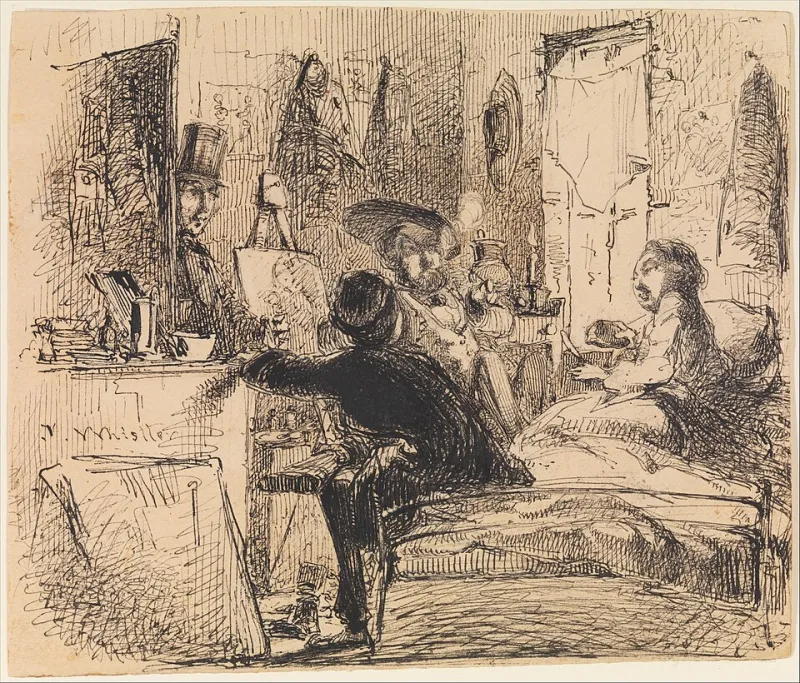
Photo: James McNeill Whistler, CC0, via Wikimedia Commons
The Sketchbook You'd Never Post
There's a sketchbook on a shelf somewhere — maybe yours, maybe a friend's — that will never make it to Instagram. It's messy. It contradicts itself. Half the pages are embarrassing in a way that feels too honest, too raw, too unresolved to share. And weirdly? It's probably the most interesting thing that person has ever made.
We live in a creative culture that's obsessed with output. Finished things. Shareable things. Things that fit neatly into a grid or a portfolio or a story arc that ends with "and then I figured it out." But a lot of working artists — the ones who've been doing this for years — will tell you quietly that the stuff they never show anyone is where the real experimentation happens. It's where they're actually free.
That tension is worth sitting with.
Finished Doesn't Mean Fully Realized
Here's something that gets glossed over in a lot of creator content: there's a difference between a piece of work being done and a piece of work being complete. Finished means you stopped. Complete means it arrived somewhere. Those aren't the same thing, and conflating them is one of the quieter ways creators end up feeling hollow about their own output.
When everything you make is heading toward publication — toward a post, a drop, a launch — you start editing before you've even begun. You're already imagining the caption, the feedback, the way it'll look against your other work. That's not creation. That's curation happening a step too early, and it quietly kills off the weirdest, most interesting ideas before they get a chance to breathe.
Private work doesn't have that problem. When nothing is at stake, you can try things that are genuinely bad. You can follow a thread that goes nowhere. You can make something ugly and keep making it uglier just to see what happens. That's not wasted time — that's how you find out what you actually think.
The Hidden Body of Work
A lot of artists maintain two parallel creative lives, even if they don't talk about it that way. There's the public work — the portfolio, the releases, the stuff that represents them out in the world — and then there's the private practice, the ongoing conversation they're having with themselves that never quite makes it to an audience.
This isn't perfectionism, exactly. Perfectionism is the fear that what you've made isn't good enough. This is something different. It's the recognition that some creative work isn't meant to be consumed — it's meant to be lived in. It's research. It's play. It's the artistic equivalent of talking to yourself in the car, which, for the record, is one of the most useful things humans do.
Some of the most influential artists in American creative history kept journals, notebooks, and private experiments that their contemporaries never saw. The public got the polished version. The private version is what made the polished version possible.
When Sharing Becomes the Default
Social media didn't invent the pressure to share your work — but it absolutely turned up the volume. Platforms reward consistency and frequency. Algorithms like creators who show up constantly, which means the psychological pressure to convert every creative moment into content is basically structural at this point.
And look, there's nothing wrong with sharing your process. Behind-the-scenes content is genuinely interesting. Audiences connect with authenticity. But there's a difference between choosing to share your process and feeling like everything you make is automatically a candidate for public consumption. That second thing is exhausting, and it changes how you make things in ways that are hard to track.
When you know something might be shared, you start performing — even just a little. You make choices that are legible to an outside eye rather than choices that are true to whatever you're actually trying to figure out. The work becomes communicative when it should still be exploratory.
Giving Yourself Permission to Keep Things
This isn't an argument against sharing. It's an argument for having something you don't share — not because it's not ready, but because it's yours.
That could look like a lot of things. A physical journal. A folder on your desktop labeled something boring so you don't feel the urge to open it with an audience in mind. A practice you do before you do the work that anyone sees — something that warms you up without the overhead of presentation.
The point isn't secrecy for its own sake. It's about protecting a space in your creative life where the stakes are genuinely low. Where you can be wrong. Where you can be weird. Where you can make something that doesn't resolve and just let it sit there, unresolved, without deciding what it means yet.
The Paradox of the Private Masterpiece
Here's the strange thing: a lot of creators report that the work they never showed anyone ends up being the work that most directly influenced everything else they made. Not because it was secretly great — sometimes it wasn't — but because it was free in a way the public work couldn't be.
That freedom has downstream effects. It loosens things. It reminds you why you started making things in the first place, before anyone was watching, before there was a brand or an audience or a content calendar. It puts you back in contact with the version of yourself that made stuff just to find out what would happen.
You don't owe anyone access to every corner of your creative life. Some of your best work might live permanently in a drawer, and that's not a failure — it's a resource. The unshared thing isn't the unfinished thing. Sometimes it's the most finished thing you've got.