That Cringeworthy First Draft Is Telling You Something You Need to Hear
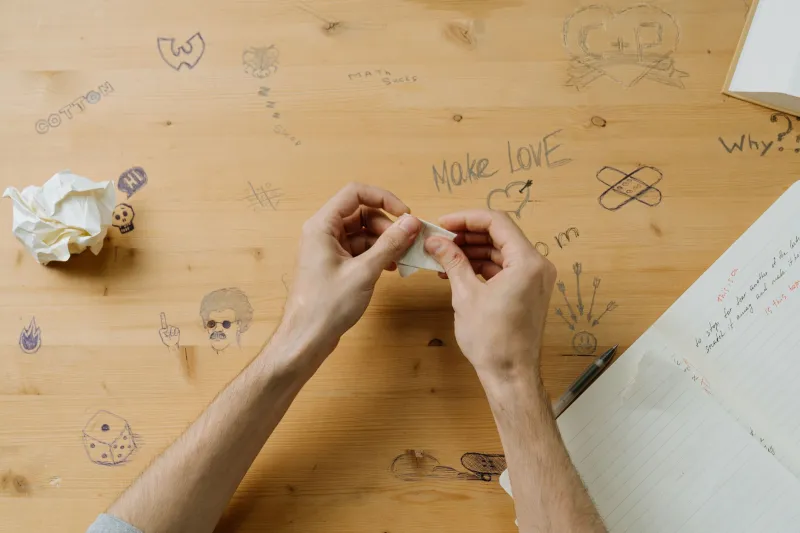
Somewhere on your hard drive — or buried in a notebook, or tucked into a folder you renamed something vague like "old stuff" — there's a version of your work that makes you wince. Maybe it's a painting that looks like you held the brush with your non-dominant hand. Maybe it's a short story where every sentence is trying way too hard. Maybe it's a song demo where you can hear yourself breathing too loud and the chord changes are all wrong.
You probably haven't opened it in months. Maybe years.
Here's the uncomfortable thing: that draft might be more honest than anything you've made since.
The Refinement Trap
There's a version of getting better at your craft that's actually a slow drift away from yourself. You learn the rules. You internalize feedback. You stop making certain mistakes because you've trained yourself out of them. And most of the time, that's genuinely good — growth is real, skill matters, and nobody's arguing that you should stay bad on purpose.
But refinement has a shadow side. Every time you smooth something out, you're making a choice about what belongs and what doesn't. And sometimes, without realizing it, you're editing out the parts that were awkward because they were true — not because they were actually wrong.
The rough edge you filed down might have been the whole point.
Early drafts tend to carry a kind of desperation that later versions lose. When you don't know what you're doing yet, you're not performing competence. You're just reaching. And that reaching — messy and uncoordinated as it is — often lands closer to the emotional core of the thing than the cleaner version you spent three weeks revising.
What "Embarrassing" Usually Means
When creators describe their early work as embarrassing, they usually mean one of a few things. It's technically rough. It's emotionally exposed in a way that feels naive in hindsight. Or it's trying to say something that they later decided was too obvious, too personal, or too weird to put out into the world.
That third one is the interesting one.
A lot of what gets labeled "embarrassing" is just unguarded. You hadn't learned yet to anticipate how an audience might receive something, so you made the work for yourself — or for no one at all. You weren't optimizing. You were just making.
There's a reason so many artists, when they look back at their earliest work, describe it as having an energy they can't quite replicate. It's not nostalgia. It's that the work was made before self-consciousness had a chance to set in. Before you knew enough to second-guess yourself into something safer.
Revisiting Without Flinching
Going back to an old draft is genuinely uncomfortable. That's sort of the point. But there's a difference between cringing at the craft — the clunky sentences, the muddy color choices, the lyrics that don't scan — and cringing at the impulse behind it.
When you look at an old piece of work, try to separate those two things.
The execution might be rough. Fine. But what were you actually going for? What feeling were you chasing? What did you want that piece to do, back when you had no idea how to make it do anything? Sometimes the answer is sitting right there in the messiest part of the draft — the part you would definitely cut now — because that's where you hadn't learned to hide yet.
One useful exercise: find the moment in an old draft that makes you cringe the hardest. Not because it's technically bad, but because it feels too naked. Sit with that for a minute. Ask yourself whether you'd make that same move today. If the answer is no, ask why. Is it because you've grown? Or because you've gotten more careful?
Those are very different answers.
The Honesty That Gets Polished Away
There's a particular kind of creative honesty that's almost impossible to manufacture once you know what you're doing. It shows up in early work because it's accidental — you didn't know enough to be strategic about what you revealed. You just put the thing down and moved on.
Later, you learn to be intentional about vulnerability. Which sounds like a good thing, and often is. But intentional vulnerability is still a performance of a kind. It's calculated openness. The rawness in an early draft is different — it's just rawness. There was no calculation. You were fumbling around in the dark and you left your handprints on the wall.
That's not something you can fake once you've learned to see in the dark.
This doesn't mean you should stop developing your craft or deliberately produce bad work to seem authentic. It means that occasionally, when you're stuck or feeling like your recent work has gotten a little too polished and a little too airless, going back to an old embarrassing draft can function almost like a compass reset. It points you back toward whatever you were originally trying to find.
What to Do With What You Find
You don't have to publish the old draft. You don't have to share it, frame it, or pretend it's better than it is. But you can mine it.
Maybe there's an image in there you abandoned that still has legs. Maybe the emotional logic of the piece — even if the execution was a disaster — is actually more interesting than what you replaced it with. Maybe the whole mess of it reminds you of a question you used to be asking that you quietly stopped asking once you got more comfortable.
Some creators keep a folder specifically for this. Old sketches, early drafts, rough recordings — not as an archive of failure, but as a library of original impulses. Something to return to when the current work starts to feel a little too clean.
Because clean is nice. Clean is often necessary. But clean isn't always the same as true.
And sometimes the most useful thing you can do for your work right now is go find the version of yourself who didn't know enough to be embarrassed — and figure out what they were trying to tell you.