The Flop That Told the Truth: Learning to Honor Your Worst Creative Work
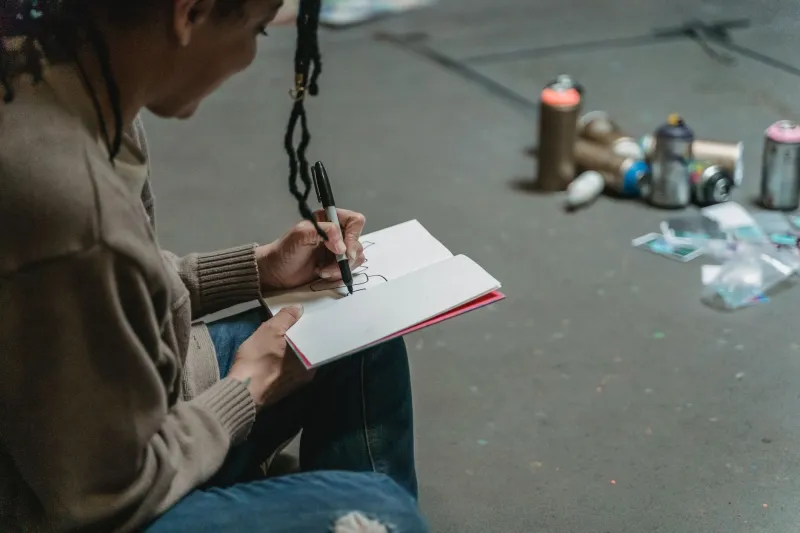
There's a piece I made about three years ago that I will never show anyone. It's not unfinished — that would almost be easier to explain. It's completely finished, in the way that a meal is finished when you eat it and realize halfway through that you should have ordered something else. It exists. It's whole. And it is, by any honest measure, not good.
For a long time, I kept it buried in a folder with a vague filename, the creative equivalent of shoving something under the bed before company comes over. But lately I've been thinking about why I still have it at all. And I think the answer is weirder than I expected.
That piece might be the most truthful thing I've ever made.
What We Actually Mean When We Say "Learning Experience"
The creative world has a very tidy way of talking about failure. We call it a stepping stone. A necessary part of the process. We say things like you have to make bad work to make good work, which is true, but it also quietly frames failure as instrumental — useful only insofar as it points toward something better.
That framing is comforting. It keeps failure in its place, somewhere behind you on the road, receding in the rearview mirror as you improve. You failed, you learned, you moved on. Neat.
But what if that's not the whole story? What if some failures aren't stepping stones to anything? What if they're just — complete?
I'm not being defeatist here. I'm asking a genuine question about what we lose when we treat every failed piece as raw material for future success rather than as its own finished object, awkward edges and all.
The Honesty Problem With Good Work
Here's something nobody really talks about: successful creative work involves a lot of editing. Not just the literal kind — cutting sentences, adjusting colors, re-recording a take — but a deeper, more continuous editing of yourself. The version of you that makes good work is, in some ways, a curated version. You've learned what to keep and what to hide. You've gotten better at controlling the signal.
Your worst work doesn't have that control. It's the version of you that didn't know how to hide yet.
Think about the last time you made something that truly didn't land. Maybe the concept was muddy. Maybe the execution was off. Maybe it just had this desperate, reaching quality that you can feel even when you look at it now. That desperation? That's real. That reaching? That's you, unfiltered, before the craft kicked in to smooth things over.
There's a kind of rawness in failure that success, almost by definition, polishes away.
The American Hustle and What It Costs Us
In the US, we have a particular cultural allergy to sitting with failure. The whole mythology — startup culture, the comeback arc, the underdog story — is built around failure as a temporary state, a plot point before the turnaround. We don't really have a framework for failure as a destination, as something that just... is.
Creators absorb this. We post the highlight reel. We talk about our process in terms of growth. We package our stumbles into lessons that make us look thoughtful and resilient. And there's nothing wrong with that, exactly. But it does mean we never really look at the flop on its own terms.
What would it mean to let a failed piece just exist? Not as proof that you're human, not as a lesson in humility, not as a contrast that makes your successes look better — but just as a thing you made that didn't work, and that's the whole story?
The Anatomy of a Real Flop
When I go back to that buried piece, here's what I notice: it's trying too hard in exactly the places I was most uncertain. The overcorrection is visible. The anxiety is baked into the structure. It's like you can see my hands shaking.
And that's not nothing. That's actually a lot.
Skilled work hides effort. That's part of what makes it skilled. But hiding effort also means hiding the state you were in when you made it — the doubt, the confusion, the weird specific mood of a Tuesday afternoon when you weren't sure what you were doing but you did it anyway.
Failed work preserves all of that. It's less like a finished painting and more like a photograph of the studio mid-process, drop cloths and all.
Completion Doesn't Require Success
I want to push back gently on the idea that work is only complete when it succeeds. That standard — where a piece earns its existence by landing well, by finding an audience, by achieving what it set out to do — is a pretty brutal way to measure creative output.
Some things are complete because they're done. Because you put them down. Because they exist in the world, even if only in a folder with a vague filename.
There's a quiet dignity in that. Not the dignity of achievement, but the dignity of having shown up and tried something that didn't work, fully and without reservation.
That piece of mine didn't fail because I didn't care. It failed, I think, because I cared too much and didn't yet know how to carry that weight. Seeing it now is like running into a younger version of myself — a little embarrassing, a little tender, and honestly kind of moving.
What Happens If You Stop Running
I'm not suggesting you post your worst work. I'm not making an argument for radical creative vulnerability or some kind of therapeutic public self-flagellation. Some things are private, and they're allowed to stay that way.
But there's something worth trying in the act of just... not running from the flop. Letting it sit in the folder without shame. Not forcing it into a lesson. Not reframing it as a necessary detour on the road to better work.
Just letting it be the thing it is: a complete, honest, not-very-good piece of work that came from you, for real, on a real day when you were doing your best.
That's not nothing. That might actually be everything.
The work that succeeds shows the world what you can do. The work that fails shows something closer to who you are. Both of those things deserve a little room to breathe.