The Idea That Lives in Your Chest and Nowhere Else
There's a piece I've been trying to make for about six years. I can see it completely. The feeling of it, the texture, the way it would move through whoever encountered it. I know exactly what it would do to a room, or a page, or a screen — I just can't figure out which one of those it belongs in. Every time I try to drag it into the physical world, something collapses. The translation fails. What comes out is a pale, embarrassing copy of the thing that lives, fully alive, inside my head.
I used to think this was a skill problem. Get better, and eventually the gap between vision and execution closes. But the longer I've been making things, the more I suspect that some ideas aren't waiting for you to level up. They're just not makeable. Not yet. Maybe not ever. And that's a category of creative experience almost nobody talks about honestly.
The Vision That Resists Every Medium
Most creative frustration gets framed as a craft issue. You don't have the technical chops. You need better tools. You haven't put in enough hours. And sure, sometimes that's true. But there's a specific kind of idea — and you probably have one — that doesn't fit neatly into that explanation.
It's the short film that would require a budget you'll never have. The novel that needs a narrative structure that doesn't exist yet. The installation piece that would take up three city blocks and the permission of a government agency. Or, stranger still, the work that seems to live between mediums — not quite music, not quite visual, not quite language — and every time you try to pin it down to one, it loses the thing that made it worth making.
These aren't half-formed ideas. They're often the most complete ideas you have. The problem isn't that they're vague. The problem is that they're too specific for the tools available to you.
Does an Unmakeable Work Still Count?
Here's the uncomfortable question: if a piece never gets made, does it matter? In a culture obsessed with output, shipping, and showing your work, an idea that stays permanently in your head feels like a failure. Or worse — like an excuse.
But I'd argue that these impossible visions do something real and important. They set a standard. They become a kind of internal compass that calibrates everything else you make. When you're working on something that can be finished, the unmakeable thing in the background is quietly asking: does this have that quality? Is this getting close to the feeling I'm after?
Some of the most interesting artists I've encountered — not famous ones, just people genuinely deep in their practice — talk about one or two ideas they've carried for years without realizing them. And when you look at their actual body of work, you can feel those phantom projects everywhere. The unmade thing casts a long shadow over everything that does get made.
The Procrastination Problem
Okay, but let's be honest about the other side of this. Because the unmakeable work can also be a very comfortable hiding place.
It's easy to romanticize the idea that lives only in your head, because it never has to be judged. It never fails. It never gets a lukewarm response or a confused look from someone who doesn't get it. The version in your mind is perfect because it's untested. And there's a real risk that some creators use their impossible vision as a reason — conscious or not — to avoid making the harder, messier, more vulnerable thing: actual work.
The question worth sitting with is: are you haunted by this idea, or are you hiding behind it? Both can look the same from the outside. Both involve a lot of staring out windows and sighing meaningfully. But one is feeding your practice and the other is quietly strangling it.
A useful gut-check — are you still making other things? Are you still showing up to the work that can be done? If yes, then the unmakeable idea is probably doing its job. If you've stopped finishing anything because nothing measures up to the vision in your head, that's worth paying attention to.
What Happens When You Try Anyway
Sometimes the most useful thing you can do with an unmakeable idea is attempt it badly.
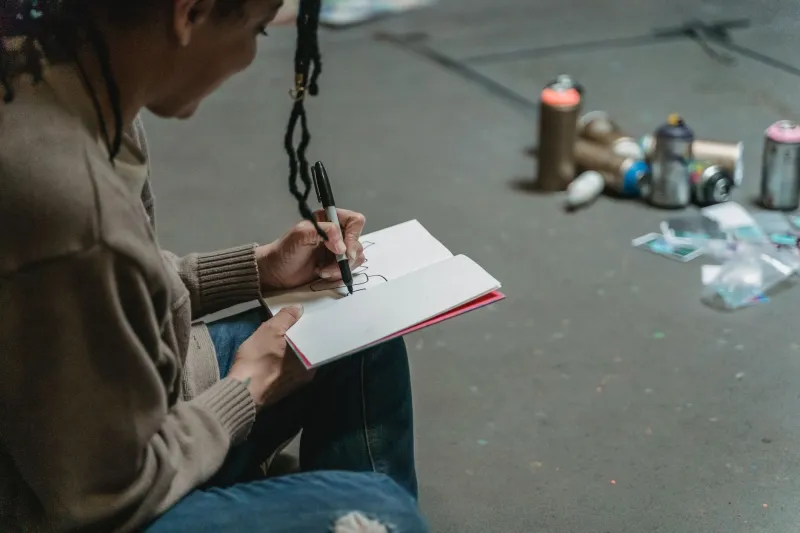
Not to produce the real thing — you already know that's not happening, at least not right now. But to sketch the edges of it. To make a rough, embarrassing, obviously-incomplete version that captures maybe fifteen percent of what you're going for. This does two things. First, it gets the idea out of the sacred space in your head and into the messy, real world where it can breathe and change. Second, it sometimes reveals that the idea wasn't as impossible as you thought — it was just intimidating.
Other times, the bad attempt confirms what you suspected: the thing genuinely can't be made yet. And that's okay too. You've learned something about the idea's edges. You've pushed on it and felt where it pushes back. That's not wasted effort.
There's also something quietly liberating about making a version you've already decided is a failure. The pressure drops. You stop performing and start actually exploring. Some of the most surprising creative discoveries come from attempts that were never meant to succeed.
Carrying the Work You Can't Make
I don't think the goal is to eventually make every unmakeable thing. Some of them will stay where they are — in your chest, behind your eyes, shaping you from the inside without ever becoming an object in the world. And that might be exactly right.
What matters is how you carry them. Are they a source of longing that keeps you reaching? Or are they a source of shame that keeps you stuck? The same idea can be either one, depending on how you hold it.
The most honest version of a creative life probably includes a few of these permanently unrealized visions. Not as failures. Not as proof that you're not good enough. But as evidence that your imagination runs slightly ahead of your hands — and that's not a problem to solve. That's just what it feels like to be someone who makes things.
Keep trying to catch up. Make the stuff you can make. And let the impossible idea do what it does best: remind you why any of this matters in the first place.