Make Something Nobody Asked For
Photo: 선의의 바람, CC BY-SA 4.0, via Wikimedia Commons
At some point, most creators start reverse-engineering their own work. You notice what lands, what gets saved, what gets shared. You file it away. You do more of that. It's not cynical — it's just pattern recognition, and pattern recognition is how humans survive.
But here's where it gets slippery: eventually you might realize you haven't made anything in months that you actually wanted to make. You've been making things you expected people to want. And those aren't the same thing.
The Invisible Audience That Moves In
It doesn't happen all at once. The invisible audience installs itself gradually — a comment here, an analytics dashboard there, a passing remark from someone you respect. Before long, there's a ghost in your creative process that wasn't there before. A presence you're performing for, even when no one's watching.
This is one of the stranger side effects of building any kind of following, even a small one. The audience doesn't have to be in the room to influence the work. They live in your head now, and they have opinions.
The question isn't whether this happens — it happens to almost everyone eventually. The question is whether you notice it happening, and whether you're okay with it.
What "For Yourself" Actually Means
When people say "just make it for yourself," it can sound like advice to be precious and self-indulgent. But that's not what this is.
Making something for yourself means making something where your curiosity is the primary compass. Where you're not asking "will this resonate" before you've asked "is this true." Where you follow the thread that interests you even if you can't articulate why it's interesting yet.
It means tolerating the discomfort of not knowing if it's good, because the metric of "good" you're using isn't borrowed from anyone else.
This is actually harder than it sounds. Most of us have spent years developing taste through exposure to other people's work and other people's reactions. Separating your genuine instincts from absorbed expectations is real, ongoing labor.
The Paradox That Keeps Coming Up
Here's the thing that creators who've been at this for a while tend to notice: the work they made with zero audience consideration often connects the most deeply.
The painting that was too personal to post. The essay that felt too weird to publish. The project they made in a weird format for no commercial reason. These are the things that tend to find their people — sometimes years later, sometimes in ways the creator never anticipated.
There's a reason for this. When you're making something purely from your own genuine interest, without the filter of anticipated reception, the work tends to be more specific. And specificity is what creates connection. Vague, broadly appealing work slides off people. Work that's deeply, unapologetically particular — that's what gets under someone's skin.
The audience of one, it turns out, is often a more reliable guide to resonance than the imagined crowd.
Giving Yourself Explicit Permission
This is the part that sounds too simple and isn't: you have to actually decide to do this. Not as a vague aspiration, but as a deliberate choice for a specific project.
Pick something. A piece, a series, a medium you've been curious about. Declare it — even just to yourself — off-limits for audience consideration. No posting schedule. No thinking about how to caption it. No imagining the response.
This is harder than it sounds because the habits are deep. You might start a piece with good intentions and find yourself, twenty minutes in, mentally composing the description you'd write if you posted it. That's okay. Notice it, set it aside, come back to the thing itself.
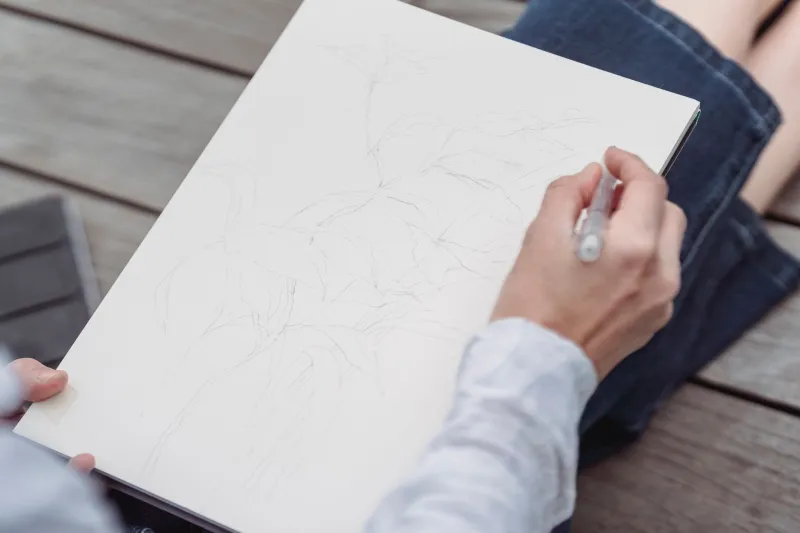
Some creators find it helps to make the work in a format that can't easily be shared — a sketchbook instead of a canvas, a voice memo instead of a produced track, a document that isn't connected to any platform. The friction of translation creates a useful buffer.
What You Might Find
When you start making things with no one in mind, a few things tend to happen.
First, you might feel surprisingly uncomfortable. The absence of an imagined audience can feel like silence in a room where there used to be noise. Some people interpret this as the work being bad. It usually isn't — it's just unfamiliar.
Second, you might find that some of what you make is genuinely weird or unfinished or not very good. That's fine. That's part of it. Not everything needs to be a finished product.
Third — and this is the part worth holding onto — you might find something in there that feels like yours in a way that a lot of your other work doesn't. A quality, a preoccupation, a way of seeing that's been there all along but got crowded out by the noise of trying to communicate it.
That's the thing you were looking for.
The Radical Part
Calling this "radical" isn't hyperbole, at least not in the current creative landscape. We live in an era where almost every tool for making things is also a tool for distributing things, where the line between creation and publication has basically dissolved. Making something with no intention of sharing it — or sharing it only after it's fully on its own terms — goes against the grain of how most creative platforms are designed.
But that friction is the point. The things that are hardest to do in the current environment are often the things most worth doing.
An audience of one is enough to make real work. It always has been.