Half-Said and Whole: The Creative Power of Never Finishing Your Thought
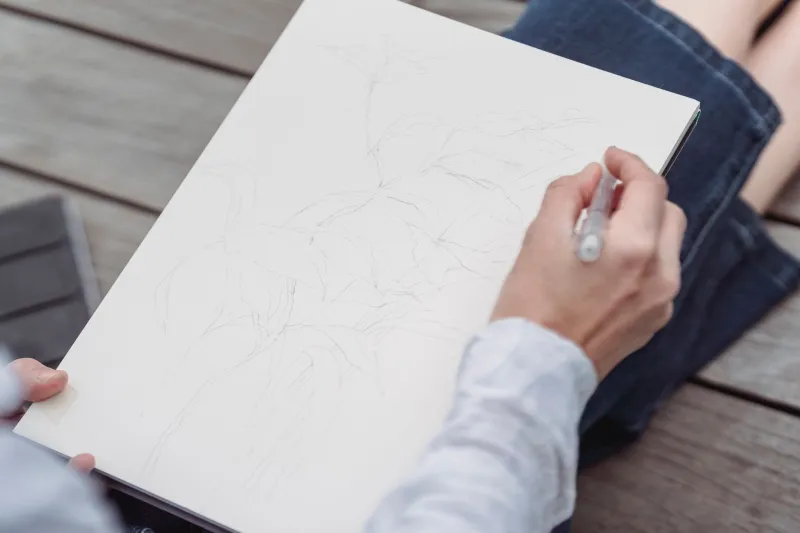
There's a particular kind of discomfort that comes with leaving something unresolved. A sentence that trails off. A melody that doesn't land on the tonic. A painting where half the canvas stays raw and untouched. We're trained — by school, by social media, by the relentless polish of professional portfolios — to see incompletion as a problem to fix. Something to apologize for.
But what if the trailing edge is exactly where your voice lives?
The Finished Thing and What It Costs
When you finish something, you're making a commitment. You're saying: this is what I meant. That's powerful. It's also, in a quiet way, a kind of death for the work. Once it's done, it stops becoming. It just is.
A lot of creators know this feeling — that strange deflation after completion, when the thing you were chasing suddenly has edges and corners and can be held up and judged. The unfinished version had more possibilities. It could have gone anywhere.
There's a reason Franz Kafka asked his friend Max Brod to burn everything he hadn't finished. He didn't see those fragments as lesser work — he saw them as too exposed, too close to the nerve. Brod published them anyway, and what we got was The Trial, The Castle, stories that end mid-sentence and somehow feel more complete than novels three times their length. Kafka's incompletion wasn't accidental. It was structural to how he understood truth.
You don't have to be Kafka to recognize that instinct in yourself.
When the Sketch Is the Statement
In visual art, there's a long tradition of the non finito — literally "not finished" in Italian. Michelangelo left figures half-emerged from marble, and art historians have spent centuries debating whether it was intention or circumstance. Rodin did something similar. What's interesting is that nobody looks at those works and thinks he ran out of time. They look at them and feel something specific: the sense of a form still in the act of becoming.
That tension — between what's there and what isn't — is doing enormous emotional work.
In music, lo-fi and bedroom pop have built entire aesthetic universes around the unfinished sound. Artists like Alex G or early Grouper releases aren't polished because polish would destroy the point. The hiss, the cut-off lyric, the song that fades before the chorus resolves — these aren't production limitations. They're the message. The roughness is the intimacy.
And in writing, the fragment has its own proud lineage. Anne Carson's Nox, which is essentially a meditation built from broken translations and family photographs, never resolves into a clean narrative. That's what makes it devastating. Emily Dickinson's dashes — those little punctuation interruptions she scattered through her poems — aren't pauses. They're gaps. Places where language openly admits it can't get there.
Incompletion as Aesthetic Identity
Here's where it gets interesting for working creators today, especially those building something personal online.
Your aesthetic isn't just your color palette or your subject matter. It's also your relationship to resolution. How much do you explain? How much do you withhold? Where do you stop?
Some creators have made their signature the deliberate half-thought. The visual artist who posts process shots but rarely the finished piece. The writer who publishes essays that ask questions without answering them. The musician who drops voice memo recordings of ideas that never became songs. These aren't creators who couldn't finish — they're creators who decided that finishing was beside the point.
What they're actually doing is trusting their audience with the in-between. And that trust is its own kind of intimacy.
In an era of over-produced content — where every YouTube video has a thumbnail that looks like a movie poster and every Instagram grid is curated within an inch of its life — the unfinished thing is genuinely countercultural. It says: I'm not trying to sell you a perfect version of this. I'm showing you where I actually am.
The Practical Question: When Do You Stop?
This doesn't mean every half-baked idea deserves an audience. There's a difference between intentional incompletion and just being undisciplined. The distinction is awareness.
Ask yourself: Does stopping here create something, or does it just avoid something?
If you're leaving a piece unresolved because you're scared of how it'll land when it's done — that's avoidance. If you're leaving it unresolved because the open edge is doing something that a closed one wouldn't — that's a choice. One of those is craft. The other is procrastination wearing craft's clothes.
The honest version of this practice means sitting with a piece and asking what it actually needs, not what would make you feel safe. Sometimes it needs to be finished. Sometimes it needs to stop exactly where it is, mid-breath, before you've said everything.
What the Gap Lets In
There's an old idea in Japanese aesthetics called ma — often translated as negative space, but more accurately understood as the meaningful pause. The silence between notes. The empty room in a composition. Ma isn't absence. It's presence of a different kind.
Your unfinished thought functions like ma. It creates room for the person receiving your work to bring something of their own. A completed idea is a closed loop — you go in, you come out, everything's resolved. An incomplete one is an open door. The reader, the listener, the viewer walks through it and keeps going somewhere you didn't map.
That's not a failure of communication. That's communication at its most generous.
Your Signature Might Be a Pause
If you've been beating yourself up for the ideas you never finished, the projects that stalled, the pieces that exist in some permanent middle state — it might be worth looking at them differently. Not as evidence of your inadequacy, but as evidence of something real about how your mind works.
Maybe your instinct to stop before the end isn't a bug. Maybe it's the most honest thing about your creative voice.
The unfinished thought isn't always the one that got away. Sometimes it's the one that stayed exactly where it needed to.