Boxed In and Finally Free: Why the Best Creative Work Happens Inside Tight Limits

Here's a scenario most creators know too well: you finally get a free weekend, no deadlines, no obligations, total creative freedom. You sit down to make something. And then… nothing. You cycle through seventeen half-ideas, open and close three different apps, rearrange your desk, and eventually watch TV. The freedom was supposed to feel like oxygen. Instead it felt like drowning in open water.
This isn't a discipline problem. It's a constraint problem — or more specifically, a lack-of-constraint problem.
There's a counterintuitive truth hiding in the way creative work actually gets done: boundaries don't block the work. They are the work. Limitations — whether self-imposed, accidental, or handed down by circumstance — give your brain something to push against. And that friction? That's where interesting things happen.
The Blank Page Isn't Freedom, It's a Trap
Psychologists have a name for what happens when we're handed too many options: decision paralysis. Barry Schwartz wrote about it in The Paradox of Choice, and while he was mostly talking about buying salad dressing, the principle maps cleanly onto creative life. When everything is possible, choosing one direction feels like closing off infinite others. So you choose nothing.
Constraints short-circuit that paralysis. When you only have three colors of thread, you stop agonizing over which shade of blue to use. When you've committed to writing a story in exactly 500 words, you stop worrying about whether it should be a short story or a novel. The decision is already made. Now you just have to do the thing.
That's not a limitation. That's a gift.
What Musicians Have Known Forever
Look at some of the most inventive music ever recorded and you'll find constraints at the center of it. Jack White has talked openly about how he structured the White Stripes around a strict two-person, guitar-and-drums setup — partly as an artistic statement, partly to force creativity. No bass player meant the guitar had to do more. The limitation became the sound.
The lo-fi hip-hop genre built an entire aesthetic around the constraint of cheap equipment and bedroom recording. Artists couldn't afford pristine studio time, so they leaned into the crackle and warmth of vinyl samples and low-bitrate drums. The restriction created something people actively sought out.
Even classical composers worked inside rigid forms — the sonata, the fugue, the twelve-bar structure — and produced work that still hits people in the chest three hundred years later. The form wasn't a cage. It was a scaffold.
Visual Art Gets Strange When the Rules Get Strict
In the visual arts, artificial limits have been sparking innovation for decades. Think about the Dogme 95 film movement — filmmakers who pledged to shoot only with handheld cameras, natural light, and no added sound. The results were raw, immediate, and genuinely different from anything being made at the time.
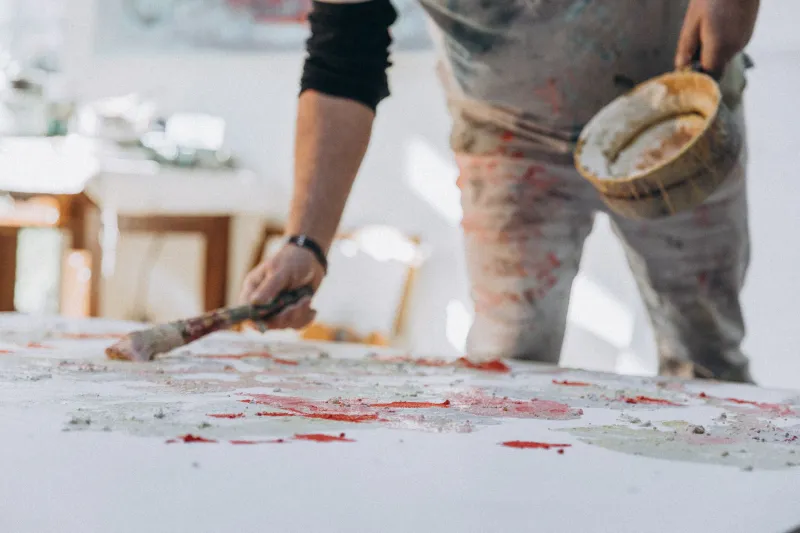
Or consider the practice of limiting your palette. Plenty of painters and illustrators set rules for themselves: only five colors, only what fits on a 4x6 card, only materials found within a mile of home. The restrictions push them toward solutions they'd never have considered with a fully stocked studio and unlimited time.
One illustrator I came across online gave herself a rule: every piece had to be finished in under two hours, no exceptions. She said it was the single best thing she ever did for her work. The time limit killed perfectionism. She made more, experimented more, and — maybe not surprisingly — got better faster.
Writing Into a Corner (On Purpose)
Writers have their own version of this. NaNoWriMo — the annual November challenge to write 50,000 words in a single month — works not because it produces polished novels (it mostly doesn't) but because the word-count constraint overrides the inner critic. You can't agonize over a sentence when you need to hit 1,667 words today. You just write.
Poetry forms like the haiku, the sonnet, or the villanelle are entire art forms built on constraint. The haiku's syllable count forces compression. The sonnet's structure demands that an argument build and turn. The limitation shapes what gets said and how it gets said, in ways that free verse sometimes can't.
Georges Perec wrote an entire novel — A Void — without using the letter E. The lipogram constraint wasn't a gimmick. It produced something genuinely weird and genuinely interesting, a book that couldn't have existed any other way.
Building Your Own Box
The good news is you don't have to wait for a constraint to be handed to you. You can build your own.
Some ideas worth trying:
- Time limits. Give yourself 30 minutes to finish something. Not to work on it — to finish it. See what you prioritize when you can't do everything.
- Material restrictions. Work with only what's already in the room. No supply runs, no online orders. What can you make with what exists right now?
- Format rules. Pick a rigid structure and stick to it. Six panels only. One paragraph. Three chords. The constraint will push you toward decisions you'd otherwise avoid.
- Scope limits. Instead of making the biggest version of your idea, make the smallest. A miniature, a sketch, a rough draft. Constraint through scale.
The point isn't to make things harder for the sake of difficulty. It's to make the decision space smaller so your creative energy can go toward the actual making.
Freedom Comes After the Box
Here's the thing about constraints that takes a while to really land: working inside them doesn't feel limiting once you're in it. It feels clarifying. The anxiety of infinite possibility gets replaced by something that feels almost like relief. This is what I'm doing. This is the shape of the thing.
That clarity is where the real freedom lives — not in the open field where you could go anywhere, but in the specific path where you know exactly where you're headed and can put your full attention on how to get there.
If your creative work has been feeling scattered or stuck lately, the answer might not be more time or more resources. It might be a smaller box. Try building one and see what crawls out.