All Art Is Borrowed: How to Build Your Own Voice From Everything You Love
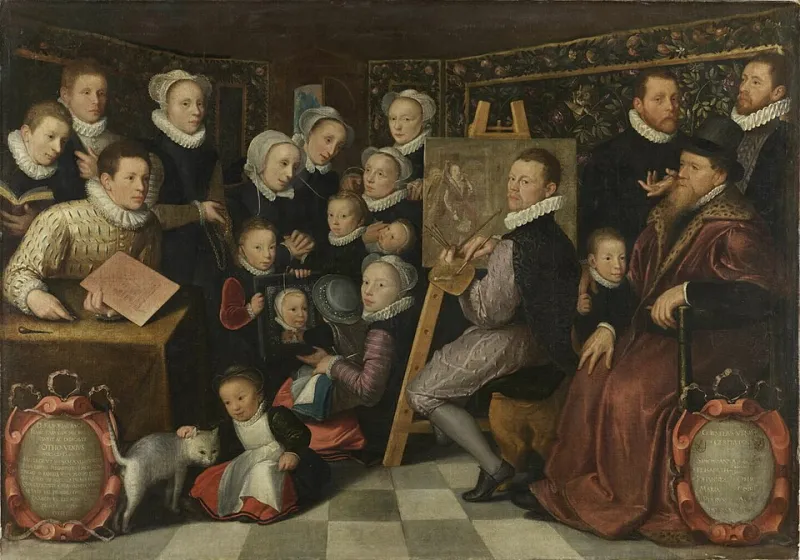
Photo: Otto van Veen, Public domain, via Wikimedia Commons
Let's just say it plainly: nobody invents themselves from scratch.
Every writer you admire was shaped by writers they admired. Every visual artist you follow has a lineage you could trace if you dug into their influences. Every musician is, at some level, a remix of everything they've ever listened to. This isn't a cynical observation — it's just how creative culture works. Art is a conversation across time, and you're joining a conversation that was already in progress before you showed up.
The problem is that the internet has made imitation both easier and more visible. When someone drops work that looks suspiciously like another creator's established aesthetic, people notice. The line between "influenced by" and "copied from" matters — creatively, ethically, and sometimes legally. So how do you actually navigate it?
Influence Is the Starting Point, Not the Destination
There's a moment in almost every creative person's development where they make work that looks almost exactly like someone they love. This is normal. It's actually necessary. Imitation is how you learn the mechanics of what makes something work — you're essentially taking something apart to see how it's built.
The issue isn't that you're doing it. The issue is whether you stay there.
Think about early Tarantino. Reservoir Dogs and Pulp Fiction are deeply indebted to French New Wave cinema, Hong Kong action films, and a dozen other influences. But nobody calls Tarantino a copycat, because he ran all of those influences through such a specific sensibility — the dialogue rhythms, the pop culture obsessions, the particular way violence and humor live right next to each other — that what came out was unmistakably his. He didn't copy his influences. He digested them.
Digestion is the key word. You're not a storage device for other people's work. You're a processing system. What goes in should come out transformed.
The Practical Difference Between Inspiration and Imitation
Here's a useful framework: inspiration changes the direction of your thinking. Imitation copies the output of someone else's thinking.
If you look at a photographer whose work you love and think, "I want to explore that same feeling of quiet solitude" — that's inspiration. If you look at their work and think, "I want to recreate that exact composition, that color grade, that subject matter" — that's imitation, and it's worth being honest with yourself about the difference.
Some practical questions to ask yourself:
- What is it I actually love about this work? Get specific. Is it the structure? The emotional tone? A particular technique? The more precisely you can name it, the better you can engage with it on your own terms.
- Am I borrowing a solution or a problem? Borrowing a solution ("I'll use that exact visual trick") is lazy. Borrowing a problem ("I want to grapple with the same themes") is how creative conversation works.
- Would my influence recognize themselves in my work? If the answer is an immediate and obvious yes, you might not be far enough from the source material yet.
Multiple Influences Are Better Than One
One of the most practical things you can do to develop an original voice is to have a lot of influences rather than just a few. When you're working from a single dominant influence, the imitation is obvious because there's nothing to dilute it. But when you're drawing from five, ten, twenty different sources — different eras, different disciplines, different cultural contexts — the synthesis becomes something new.
The writer who loves Toni Morrison and Raymond Carver and Denis Johnson is going to write something different from any of those three, because the combination doesn't exist yet. The visual artist who draws from Japanese woodblock prints, mid-century American illustration, and contemporary street art is working in a space that's genuinely their own.
Cast wide. Read outside your genre. Watch films from other countries. Look at art from other centuries. The more disparate your inputs, the more distinctive your output.
Where the Line Actually Gets Drawn
Okay, so influence is fine, imitation is complicated, but what about the actual red lines?
The clearest one is obvious: don't reproduce someone else's specific work and present it as your own. That's plagiarism, it's unethical, and depending on the context, it can have real legal consequences. Copyright law in the US protects specific expression — not ideas, not styles, not genres, but the particular way something is executed. Style itself isn't ownable. The specific execution of that style is.
Less obvious but equally important: don't build your entire creative identity on being a slightly-worse version of someone else. Not because of legal risk, but because it's a dead end for you. You can't out-Basquiat Basquiat. You can't out-Hemingway Hemingway. The only person you can be better at being is yourself, and that means doing the hard work of figuring out what you actually have to say.
The creator economy has made this more fraught in some ways. When someone blows up on social media with a specific aesthetic, there's an almost immediate wave of imitators chasing the same look. Some of those people are genuinely inspired. Some are just trying to replicate someone else's success. Audiences are pretty good at telling the difference over time — genuine creative identity has a consistency and depth that pure imitation usually can't sustain.
Finding What's Actually Yours
The honest truth is that finding your own voice is less about protecting yourself from influence and more about paying close enough attention to your own responses, obsessions, and instincts that you start to recognize what's distinctly you.
What subjects keep pulling you back even when you try to move on from them? What aesthetic choices do you make instinctively, before you've had time to think? What do people consistently respond to in your work that surprises you?
Your voice is already in there. It's built from everything you've absorbed, but it's also built from your specific life, your specific way of seeing, the particular combination of experiences and sensibilities that nobody else has. The job isn't to invent something from nothing. The job is to listen closely enough to recognize it when it shows up.
Borrow freely. Digest thoroughly. Make it yours.