What the Silence Says: The Art of Leaving Things Out
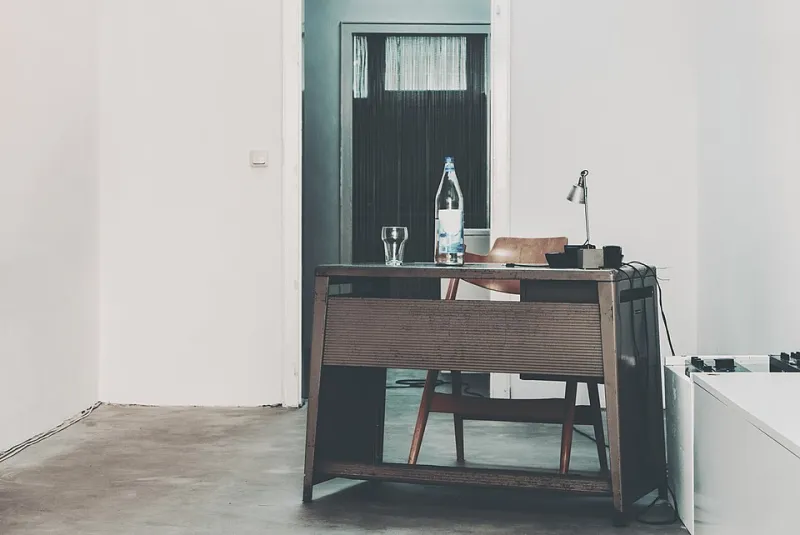
Photo: Daniel von Appen daniel_von_appen, CC0, via Wikimedia Commons
There's a scene in a short film I watched at a tiny Brooklyn screening last fall — no dialogue, no score, just a woman standing at a kitchen window while the camera holds for what felt like an uncomfortable amount of time. Nothing happens. And yet, by the time the film cut to black, half the room was quietly crying.
That moment stuck with me. Not because of what it showed, but because of everything it didn't.
We live in a content era defined by density. Every streaming platform is racing to fill every second. Social feeds are engineered to eliminate dead air. And yet, some of the most resonant creative work being made right now is defined by its restraint — by the careful, almost architectural decision to leave space where something could have been.
This isn't minimalism for minimalism's sake. It's something more intentional. It's a storytelling philosophy built around the idea that what an audience imagines is almost always more powerful than what you can show them.
The Psychology of the Gap
There's actual cognitive science behind why this works. When a narrative withholds information, our brains don't go quiet — they go into overdrive. We fill the blank with our own memories, fears, and emotional history. The story becomes personal in a way it simply can't be when everything is spelled out.
Psychologists sometimes call this the "Zeigarnik effect" — the tendency for incomplete tasks or experiences to occupy more mental real estate than resolved ones. Storytellers who understand this are essentially handing the audience an unfinished puzzle and trusting them to complete it with pieces from their own lives.
That's a profound act of creative trust. And audiences, even if they can't articulate it, feel it.
What Independent Creators Are Doing Differently
Talk to enough independent artists and a pattern emerges. The ones who are building the most devoted audiences — not the largest, but the most devoted — are almost universally the ones who resist the urge to explain themselves.
Maya, a Brooklyn-based novelist working on her second book, put it plainly: "My first draft of everything is always too much. Too many adjectives, too much interiority, too many explanations. The real writing happens when I start cutting. The book gets better every time I delete something I thought was necessary."
That instinct toward deletion is everywhere right now. Visual artists are leaving sections of canvas untouched. Podcasters are keeping the pauses in. Filmmakers are cutting away before the emotional payoff rather than sitting in it.
Jordan, an independent filmmaker based in Austin who makes short-form work that circulates largely through Vimeo and word of mouth, describes his process as "building rooms with missing walls." He wants viewers to feel the shape of something without being handed the blueprint. "If I show you the door and the window but not the whole house," he said, "your brain builds the house. And that house is yours. It means something specific to you that it can't mean if I just show you mine."
Negative Space Isn't Just Visual
In design and visual art, negative space — the empty area around and between subjects — is a foundational concept. But the principle translates across every narrative medium in ways that are worth sitting with.
In fiction, it's the chapter that ends before the conversation finishes. In music, it's the rest that makes the next note land harder. In film, it's the cut away from the face right before the tears come. In a photograph, it's the subject positioned off-center with open sky beside them, inviting your eye to wander into the unknown.
Each of these is a deliberate act of withholding. And each one, done well, pulls the audience deeper in rather than pushing them away.
The mistake a lot of newer creators make is confusing withholding with being obscure. There's a real difference. Obscurity is about the creator — it says "you figure it out." Withholding is about the audience — it says "I trust you to bring something to this." One is alienating. The other is intimate.
The Cultural Moment for This
It's worth asking why this feels so urgent right now. Part of the answer might be exhaustion. We are swimming in content that tells us exactly how to feel — laugh tracks, swelling scores, reaction videos that perform the emotion so we don't have to. After enough of that, something quiet lands like a revelation.
But there's also something more specific happening in independent creative culture. As the tools for making and distributing work have become more accessible, the volume of content has exploded. The artists who are cutting through aren't necessarily the ones with the biggest budgets or the loudest voices. They're the ones whose work creates a stillness that the algorithm can't manufacture.
Negative space is, in a weird way, resistant to optimization. You can't A/B test a pause. You can't data-engineer the feeling of something left unsaid. It requires a human judgment call — a creator deciding to trust both their instincts and their audience simultaneously.
Making Something That Breathes
If you're a creator sitting with this, the practical takeaway isn't "make less stuff." It's more like: make stuff that breathes.
Give your work room to mean different things to different people. Resist the impulse to underline every emotional beat. Cut the line of dialogue that explains the scene that already showed it. Let the camera linger a second past comfort, then cut. Leave the last page of the chapter with one less sentence than you think it needs.
The empty space you leave isn't a void. It's an invitation. And the readers, viewers, and listeners who accept that invitation tend to become the most loyal audience you'll ever build — because the work isn't just yours anymore. It's theirs too.
That kitchen window scene still lives in me. I have no idea what the filmmaker intended. I know exactly what it meant to me. And I suspect that was always the point.