3 AM Has Your Best Ideas and Won't Give Them Back

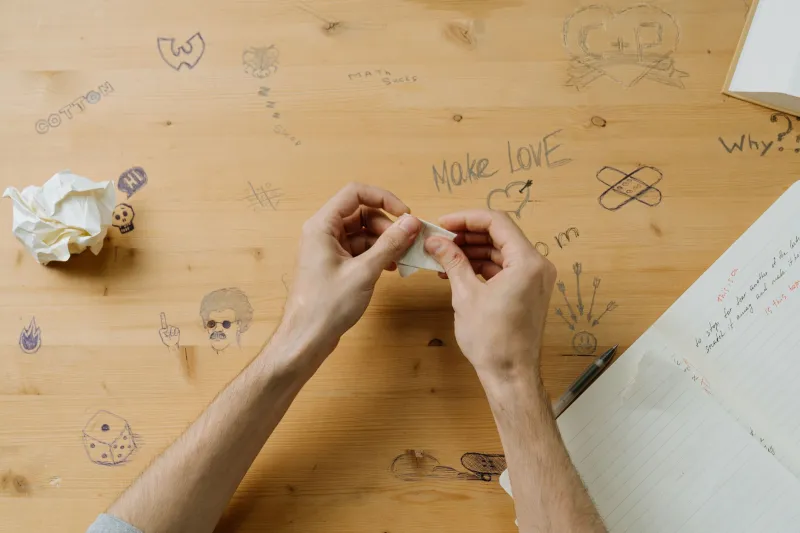
Photo: BarelyawakeFL, CC0, via Wikimedia Commons
It starts innocently enough. You're brushing your teeth before bed and a sentence arrives — perfect, fully formed, the kind you've been searching for all week. You tell yourself you'll remember it. You won't. So you grab your phone, type it out, and think: okay, now I can sleep.
Except you can't. Because that sentence dragged twelve more behind it, and now you're sitting on the edge of your bed at 1:47 AM sketching a layout in the Notes app while your partner sleeps three feet away and your alarm is set for six.
Welcome to the parasite problem.
When Passion Becomes Possession
Every creative person has experienced the good kind of obsession — the pull toward a project that makes you lose track of time, skip lunch, forget to text back. That's the engine. That's what gets things made.
But there's a second kind that doesn't feel like fuel. It feels like something living in your head that you didn't invite and can't evict. Ideas that arrive not when you're at your desk with coffee and a clear schedule, but at 3 AM, mid-shower, in the middle of a conversation about something completely unrelated. Ideas that don't wait.
The difference matters, and it's worth naming: productive creative obsession moves you toward the work. The other kind just orbits it. You think about the project constantly but somehow make less progress. You're too wired to sleep, too scattered to sit down and actually execute. You're stuck in the in-between — not resting, not creating, just spinning.
This is the part nobody talks about when they romanticize the tortured artist thing.
Why Your Brain Does This
Here's the unsexy explanation: your brain doesn't distinguish well between unfinished creative work and unresolved threat. The same mechanism that kept your ancestors mentally rehearsing tomorrow's hunt is what keeps you mentally rehearsing tomorrow's illustration series at midnight. Unfinished things create a low-grade cognitive loop. Psychologists sometimes call this the Zeigarnik effect — incomplete tasks demand more mental bandwidth than completed ones.
For creators, this means every open project is a tab your brain refuses to close. And if you've got five half-finished pieces, two ideas you haven't started, and one thing you're afraid to actually commit to? That's a lot of tabs.
Add in the fact that nighttime strips away the noise — no emails, no notifications, no social obligations — and suddenly your brain finally has the quiet it needs to process everything it was shoving aside all day. Which is lovely, except you needed that quiet to sleep.
The Notebook Isn't Enough
The classic advice is to keep a notebook by your bed. Write it down, let it go. And look, that's not wrong — externalizing an idea does relieve some of the cognitive pressure. But if you've tried this and still find yourself staring at the ceiling an hour later, the notebook isn't the problem you need to solve.
The deeper issue is usually one of two things: either you don't trust yourself to return to the idea (so your brain keeps the loop running as insurance), or the project has become a vehicle for anxiety that isn't really about the project at all.
That second one is worth sitting with. Sometimes what feels like creative obsession is actually a displacement activity — the mind would rather spin on a half-formed concept than face whatever else is underneath. The art becomes a hiding place.
Practical Ways to Quiet the Loop
If your creative mind is treating 3 AM like prime working hours, here are a few things that actually help — not just in theory, but in practice.
Create a deliberate capture ritual, not just a notebook. When an idea arrives at an inconvenient hour, write it down and then write one more sentence: what I'll do with this first. That tiny act of planning signals to your brain that the idea has a path forward. It's not just floating — it's parked.
Schedule your creative anxiety. This sounds strange, but it works. Give yourself fifteen to twenty minutes in the evening — not right before bed — to actively think about your projects. Write down what's unresolved. Let your brain chew on it intentionally, then close the document and move on. You're not suppressing the thoughts; you're giving them a container.
Notice when the obsession becomes avoidance. If you're thinking about the work constantly but not actually doing it, that's a signal. Ask yourself what's scary about sitting down and starting. Usually the 3 AM spiral is loudest around the things we most want to get right and most fear getting wrong.
Build a hard boundary between creative space and sleep space. Not just physically — mentally. Develop a wind-down routine that doesn't involve any creative work, even passive stuff like scrolling through design inspiration or reading about your medium. Your brain needs a cue that the creative channel is closed for the night.
The Work Will Still Be There
Here's the thing about intrusive creative thoughts: they feel urgent because you feel urgent. The idea doesn't actually need you to think about it at 2 AM. It needs you to be rested enough to execute it at 10 AM.
Some of the best creative decisions happen not in the frantic middle-of-the-night spiral, but in the quiet clarity that follows a full night of sleep. The idea that seemed enormous and unwieldy at midnight often looks manageable — even obvious — in daylight.
Your creative life is a long game. The work you're obsessing over right now is one piece of something much larger you're building over years, maybe decades. Treating every idea like it might disappear if you don't hold onto it with both hands is exhausting, and it's also not true.
The ideas that are really yours have a way of coming back. Let them find you rested.