Nobody's Watching and That's the Whole Point
The Pressure You Didn't Know You Were Carrying
At some point, most creators start filtering everything. A sketch goes on Instagram. A poem gets workshopped. A half-finished song gets played for a friend to gauge their reaction before it's even done. It happens gradually, almost without noticing — the internal audience shows up before the work does.
That internal audience isn't always destructive. Sometimes imagining a reader or a viewer helps you clarify what you're actually trying to say. But there's a version of it that quietly kills things before they get interesting. The version that makes you stop mid-sentence and think, would anyone care about this? The version that turns a sketchbook into a portfolio audition.
Here's the thing nobody talks about enough: some of the most alive creative work happens when the answer to "who's this for?" is genuinely, completely, no one.
What Happens When You Take the Audience Out of the Room
There's a term in psychology called evaluative apprehension — basically, the anxiety that comes from knowing you're being observed or judged. Research has shown it can significantly affect performance, often in ways that make people play it safer, aim for the expected, and avoid anything that might look weird or unfinished.
Creative work is incredibly vulnerable to this. Even the imagined presence of an audience can push you toward legibility over exploration, polish over rawness, likability over truth.
When you remove that pressure — when you make something with a genuine commitment to never sharing it — something shifts. The stakes drop in the best possible way. You stop reaching for the version of yourself that looks good and start reaching for the version that's actually curious.
That's not nothing. That's actually everything.
The Sketchbook That Never Leaves the Drawer
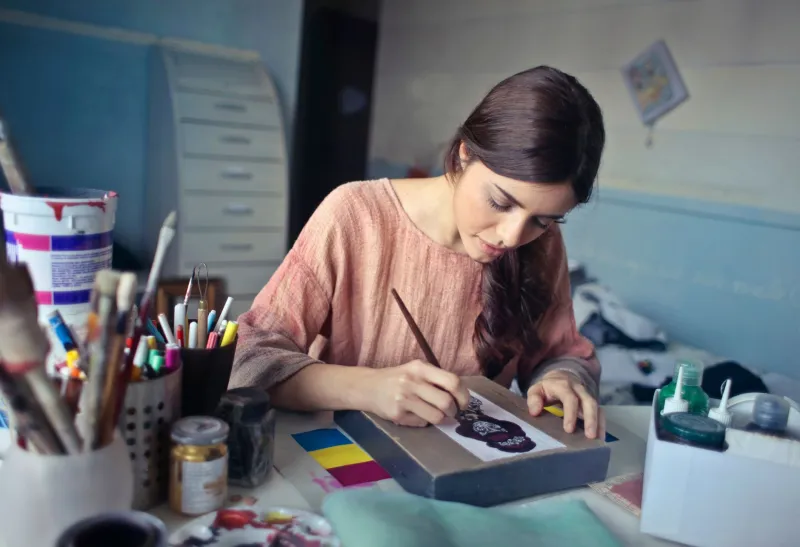
A lot of artists already know this intuitively. They keep a private sketchbook — messy, exploratory, embarrassing — that never gets photographed or posted. Writers keep journals full of rambling that would mortify them if anyone read it. Musicians noodle around on instruments recording voice memos they delete the same day.
These aren't failed works. They're not the rough drafts of something else. They're the whole point.
The private sketchbook is where you figure out what you actually think. Where you try the thing that probably won't work. Where you draw the same face fifteen times in a row because you're obsessed with getting the eyes right, not because it'll make a good post. It's where the work gets to be genuinely experimental rather than experimentally branded.
A lot of creators in the US especially feel this pressure acutely — there's such a strong cultural current around building an audience, monetizing your passion, and turning your creative identity into a platform. None of that is inherently bad. But it can crowd out the private, purposeless making that keeps a creative practice honest.
"Throwaway" Work That Isn't Throwaway at All
Here's something interesting: the work you make without any intention of sharing often ends up being some of the most technically formative stuff you do.
When you're not performing competence, you try things that are outside your current skill level. You experiment with a medium that doesn't suit your usual style. You make something ugly on purpose just to see what ugly looks like when you're the one choosing it. You fail without consequence, which means you fail more often, which means you actually learn faster.
Painters who keep private canvases — the ones they paint over, destroy, or just stack in a corner — often describe them as where they solved problems they didn't know they had. The solution shows up later in the "real" work, but it was born somewhere private and unobserved.
The throwaway piece isn't throwaway. It's the lab.
Finishing Isn't the Goal
Another thing that opens up when you're not making work for an audience: you stop needing to finish.
There's enormous pressure in creator culture around completion. Finishing things is treated as the mark of a serious artist — and there's truth in that, it does matter. But an obsession with completion can also mean you never start anything that doesn't already have a clear ending in sight.
Private, audience-free work gives you permission to stop whenever the interesting part is over. You can explore an idea for twenty minutes and then put it down without it being a failure or an abandoned project. You were never going to show it anyway. The exploration was the work.
This is actually closer to how a lot of creative thinking happens naturally — in fragments, in half-formed ideas, in the middle of something that never becomes a whole thing. Honoring that process instead of forcing every impulse into a finished product can make your creative life feel a lot less exhausting.
How to Actually Do This
If you want to build a private creative practice — one that's genuinely separate from your public work — a few things help.
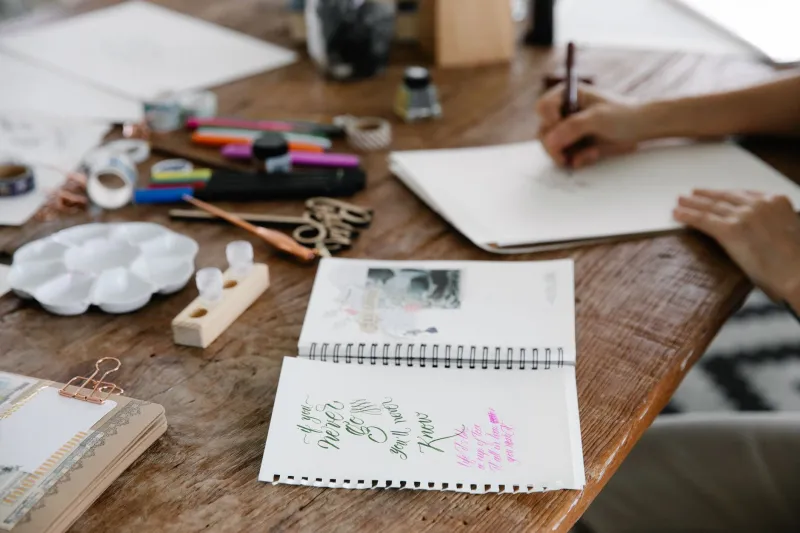
First, make the barrier to entry low. A cheap notebook, a notes app, a free drawing program. If it feels precious, you'll treat it like a portfolio. You want something disposable.
Second, be honest with yourself about the internal audience. Even when you're working privately, you might catch yourself imagining how something would land if you posted it. That's okay — notice it, and then consciously set it aside. Remind yourself this is for no one. Not even future you.
Third, consider actually destroying some of it. Not everything, but some. Delete the voice memo. Tear out the page. Paint over the canvas. There's something that happens when you commit to impermanence — it reinforces that the making was the whole point, not the artifact.
Finally, resist the urge to "recycle" everything back into public work. Sometimes a private piece should stay private. Let it be its own complete thing, even if it never fully existed for anyone but you.
The Quiet Reward
There's a satisfaction in making something no one will ever see that's genuinely hard to describe. It's not pride, exactly. It's not the satisfaction of finishing or of doing something well. It's more like the feeling of having been fully present in the act of making — without the noise of reception, without wondering how it'll land, without the low hum of self-consciousness that follows most creative work into the world.
It's just you, and the work, and the strange quiet that comes from not needing anything back.
That space is worth protecting. Especially now, when everything creative seems to want an audience, a caption, and a call to action. Some things get to just exist — briefly, privately, completely — and that's enough.