The Ghost Collaborators in Every Room You Create In
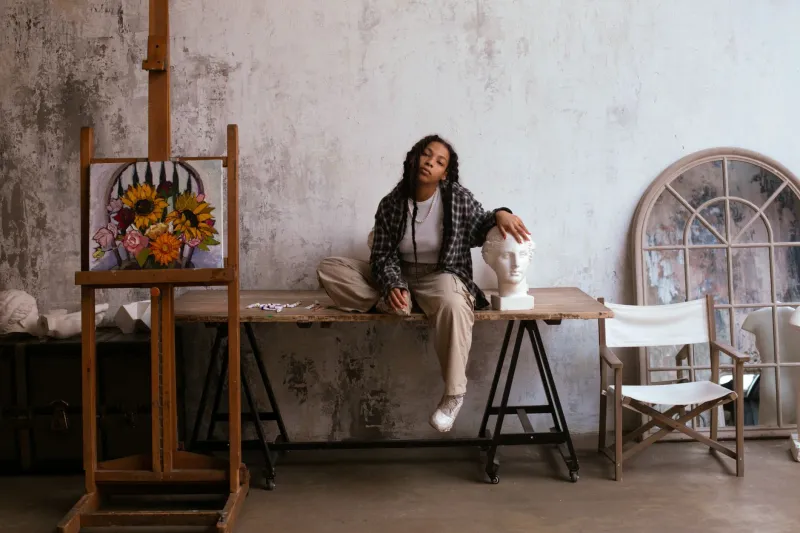
There's a painter in a studio in Portland who swears she works alone. No assistants, no creative partner, no one peering over her shoulder with opinions. Just her, the canvas, and whatever mood the morning brings.
But here's the thing: she's not alone. Not even close.
Somewhere in the way she handles negative space, you can feel the weight of a Japanese woodblock print she saw at a museum when she was nineteen. In the color choices — those muddy, complicated greens — there's an echo of a novelist she read in college whose prose she once described as "the color of wet bark." The way she lets edges go soft in the corners? That came from a documentary about a cinematographer she watched three times in a single week and then completely forgot about.
She's not copying any of this. She's in dialogue with it.
And that dialogue, invisible to almost everyone including her, is shaping every single mark she makes.
The Conversation You're Already Having
Most creative advice talks about influence like it's a conscious transaction. You study someone, you absorb a technique, you move on. Clean and linear. But the real thing is messier and honestly more interesting than that.
Influence doesn't work like a file download. It works more like a long, slow conversation where you don't always remember who said what — you just know that your thinking shifted somewhere along the way. A book you read at twenty-two is still talking to you at thirty-eight. A song you played on repeat during a hard stretch of your life encoded something in you that now shows up in your creative instincts without announcing itself.
The writers, artists, filmmakers, thinkers, and random internet strangers whose work genuinely moved you didn't just entertain you. They left behind little fragments of their perspective inside your own. And when you sit down to make something, those fragments start talking.
The question isn't whether this is happening. It is. The question is whether you're listening consciously enough to understand what the conversation is actually about.
Why It Matters to Name Them
There's a practical reason to get curious about your invisible collaborators, and it goes beyond gratitude or attribution.
When you don't know who you're in dialogue with, you can't steer the conversation. You're just reacting — unconsciously, reflexively — to influences you haven't examined. That's not always bad. Some of your best instincts live in that space. But it can also mean you're stuck in a loop, repeating aesthetic choices or thematic obsessions without understanding why, or without realizing you've moved past them.
Naming your influences — really naming them, not just the obvious ones you'd list on a bio — gives you agency. You can decide which conversations to keep having and which ones you're ready to close out. You can notice when you're arguing with an influence versus agreeing with it, which is often where the most original work gets generated.
Arguing with someone you admire is one of the most generative creative acts there is. But you can only do it on purpose if you know who you're arguing with.
The Obvious Ones and the Hidden Ones
Every creator has two lists of influences, even if they've only ever written down one.
The first list is the respectable, public-facing one. The artists you cite in interviews or mention when someone asks who shaped you. These are real and valid, but they're often the influences you've already processed — the ones you've thought about enough to articulate.
The second list is stranger and more revealing. It includes the stuff you consumed obsessively but never thought of as "serious." The TV show you watched every episode of twice. The particular illustrator whose work you followed on Tumblr in 2012 and haven't thought about since. The way your high school art teacher talked about composition, which you disagreed with at the time but apparently internalized anyway.
That second list is where a lot of your actual creative DNA lives. And most people never look at it directly.
A Few Ways to Map the Invisible
If you want to start getting a clearer picture of who's in the room with you when you create, here are some ways in.
Look at your oldest work. Not to cringe at it — though that's basically unavoidable — but to notice what it was clearly responding to. What were you trying to sound like? What aesthetic were you reaching toward? Those early influences are often the deepest ones, even if your work has moved far from them.
Track what you return to. Not what you admire in the abstract, but what you actually go back to. The album you've listened to a hundred times. The book you've recommended so often it's become embarrassing. Repetition is a signal. Something in that work is still speaking to something in you.
Notice what makes you defensive. If someone's work irritates you specifically — not bores you, but actually gets under your skin — pay attention. That friction is often a sign of a live conversation. You're reacting to a position, even if you couldn't state it out loud.
Ask what you're pushing against. A lot of creative work is defined by what it's rejecting as much as what it's embracing. What aesthetic, attitude, or approach are you consciously or unconsciously trying to move away from? That thing you're pushing against is also a collaborator, just an adversarial one.
Write a letter to a dead artist. This sounds like a journaling prompt from a workshop you'd roll your eyes at, but it works. Pick someone whose work has genuinely mattered to you and write to them about what you're making right now. What you're trying to do. What's not working. You'll be surprised what comes out — and what it tells you about the ongoing conversation.
Originality Is a Group Project
There's a version of the originality conversation that treats influence like contamination — something to be minimized, distanced from, or at least not talked about too openly. That version is exhausting and, more importantly, wrong.
The most original work tends to come from creators who have a genuinely wide and weird set of influences and who've actually metabolized them, not just collected them. The goal isn't to erase the conversation or pretend it isn't happening. The goal is to become a more conscious, active participant in it.
Your invisible collaborators aren't a threat to your originality. They're the raw material of it. The specific combination of voices you're in dialogue with — the particular mix of who shaped you, who you're arguing with, who you keep returning to — that combination is yours alone. Nobody else has had exactly those conversations.
So the work that comes out of it, if you're paying attention, can only be yours.
The room might be crowded. But you're still the one holding the brush.